
One Night in Paris

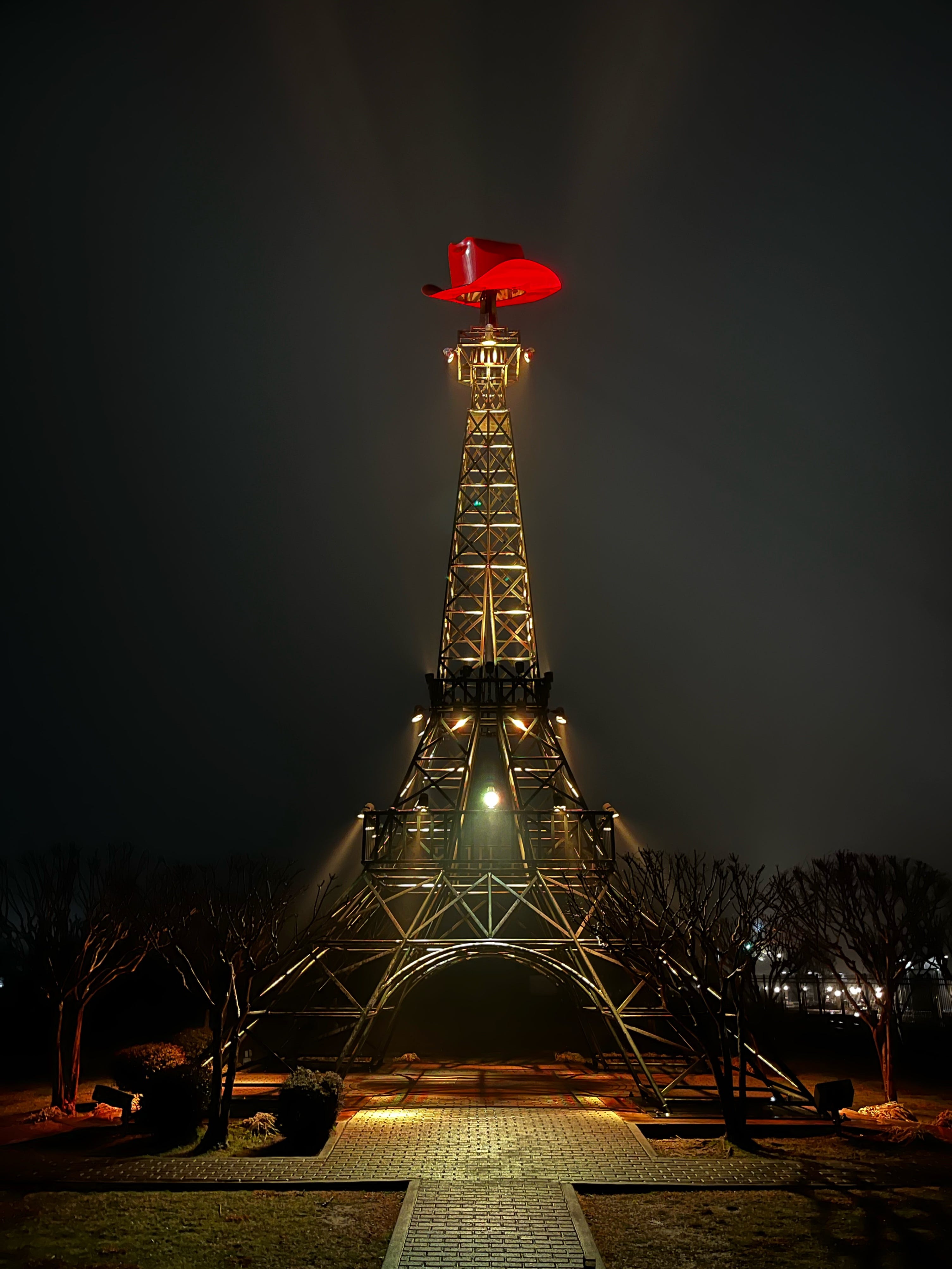
Unlike its French namesake, Paris, Texas, should probably be called the City of Darkness. Nestled in Lamar County, snug against the Oklahoma border, the 25,000 residents here have seen their share of troubled times.
Exhibit A: If you visit the Paris, Texas, Wikipedia page1, you’ll find three sentences that, placed side by side, tell you most everything you need to know about its dark, dark history:
In 1893, black teenager Henry Smith was accused of murder, tortured, and then burned to death on a scaffold in front of thousands of spectators. In 1920, two black brothers from the Arthur family were tied to a flagpole and burned to death at the Paris fairgrounds. The city has prominent memorials to the Confederacy.
[At this point, a warning—a trigger warning—is called for: some of what you’re about to read may be hard to swallow, and if you follow the links in the footnotes, it will most definitely be hard to stomach.]
Henry Smith’s death is especially troubling, in part because of the wildfire of rumor and vengeance that he found himself caught up in, resulting in a horrific public death. It all began in early January 1893 when a report came in that Smith, a local handyman, was reportedly drunk and disorderly. Sheriff’s deputy Henry Vance was sent to arrest Smith. According to a contemporary newspaper account, “the Negro was unruly, and Vance was forced to use his club.”2 The black teenager allegedly swore an oath of vengeance against the deputy. Those words came back to him on January 26 of that year when Vance’s four-year-old daughter disappeared from the front of the boarding house where her family lived. Witnesses say they saw Henry Smith pick up Myrtle Vance and carry her through the town. A mob assembled, torches were lit, hate rose in throats and bayed out like the voices of bloodhounds. You know how this ends.
Smith was eventually tracked to the terribly-named town of Hope, Arkansas, and was brought back to Paris where he was quickly lynched without a proper trial. What makes his death especially appalling is the amount of publicity it got. It made front page headlines; there seemed to be a spirit of glee among those in attendance; and photos of his mutilated body were turned into postcards. Henry’s charred corpse became the gory trading card of its day.
In documenting what happened on that day, journalist Ida B. Wells wrote: “The Paris, Texas, burning of Henry Smith, February 1st, has exceeded all the others in its horrible details. The man was drawn through the streets on a float, as the Roman generals used to parade their trophies of war, while the scaffold ten feet high, was being built, and irons were heated in the fire.”3 Later Wells wrote, “Never in the history of civilization has any Christian people stooped to such shocking brutality and indescribable barbarism as that which characterized the people of Paris, Texas.”4
Skip forward a couple of decades when Irving “Ervie” Arthur and his brother Herman, a World War I veteran, were accused of fatally shooting their landlord, John Henry Hodges and his son, William M. Hodges during a dispute. The prevailing story was that the Arthurs refused Hodges’ demand to work beyond noon Saturdays and full-Sundays.
This account was chronicled in an anonymous letter from a Paris citizen to James Weldon Johnson, Acting Secretary of the NAACP. The letter explained that Hodges compelled the Arthurs to work all day Saturday, which they did for a period; and, on Sundays, they washed and ironed their clothes. Sometime during the summer of 1920, the Arthurs refused to work past noon Saturdays and all-day Sunday. As a result, John Hodges and his son, Will, went to the brothers’ home on June 29, 1920, and took their dinner off the stove and threw it into the yard, then kicked their stove and furniture into the yard. All the while, Will Hodges held a gun on the Arthurs. He also compelled the boys to pull off their shoes and clothes and their sisters to pull off their dresses and give them to him, claiming that they were in debt to him. When the Arthurs attempted to move from the farm, permanently, three days later, the Hodges appeared again, this time firing a gun towards the family as they were packing a borrowed truck. One of the Arthur sons slipped into the house, retrieved a gun, and returned fire, killing John and Will Hodges.5
The brothers were tracked to Oklahoma and brought back to Paris for another dose of mob justice. Notice of Herman and Ervie Arthur’s impending lynching was openly advertised, to wit: “[N-word] caught. Black brutes who killed Hodges will be burned in the fairgrounds. Be on hand.”6 A crowd of 3,000 showed up and were “on hand” to cheer as the brothers were tied to a flagpole and burned alive.
Paris has been the site of 12 documented lynchings since 1892. The Arthur brothers were the last.7
But, really, they weren’t the last. Let us not forget the 2008 case of Brandon McClelland who was killed when he was first hit and run over by a vehicle, then dragged beneath it.8
You’d be forgiven if by this point you’re confusing McClelland’s murder with that of James Byrd Jr. ten years earlier in Jasper, Texas.9 Those of us who were alive and of newspaper-reading age in 1998 will never forget the grisly details of the Byrd murder. To this day, I can only glance at some of the details before I turn away in revulsion.
McClelland and Byrd were not safely encapsulated in sepia-toned history—this was the blood-pulp of an atrocity that has happened in our own lifetime. And the resulting “justice” makes it even harder to stomach. Two white men were arrested for McClelland’s death, but the prosecutor cited lack of evidence and declined to press charges, and no serious subsequent attempt to find other perpetrators was made. Following McClelland’s death, the U.S. Department of Justice tried to establish a dialogue between the races in the town, but it ended in failure when African-American complaints were mostly met by silent glares from whites in the community.
A 2009 protest rally over the McClelland case led to Texas State Police intervention to prevent opposing groups shouting “white power!” and “black power!” from coming to blows. In response to the incident, civil rights activist Brenda Cherry said, “I think we are probably stuck in 1930 right about now.”
Brandon McClelland’s death was the match dropped on a town already perched atop a powderkeg. In another case two years earlier, a 14-year-old African-American girl was sentenced by a local judge to up to seven years in a youth prison for shoving a hall monitor at Paris High School. Three months earlier, the same judge had sentenced a 14-year-old white girl to probation for arson.
Meanwhile, a banner on the town’s Chamber of Commerce website10 today reads: “Visit Paris, where Texans reach higher,” then urges: “Come to Paris, it’s always a good idea.”
On January 29 of this year, my wife Jean and I—two Pollyanna white faces traveling in a white van—stumbled into town, unaware of any of the history I’ve just recounted—a history littered with burned and brutalized bodies at the hands of folks whose skin color matched ours. Now, of course, ten months later that same skin of ours crawls with horror and revulsion when we gaze upon those Wikipedia pages.
Of course, like any good cinephile, I knew of Paris, Texas, thanks to Wim Wenders’ 1984 film—which I still haven’t seen.11 In that film, Travis Henderson (Harry Dean Stanton) is mute through part of the film. I, too, grow silent when I think of the city—which, I’m told, is a place Travis Henderson never actually reaches in the quest to find his son.
No, all I knew about Paris, Texas was that it was a good place on the map to stop for the night. Here is my ignorant-of-history journal entry for that stay….
January 29, 2025: After miles of claw-handed scrub-brush reaching for the sky, after miles of racing tumbleweeds, after miles of unwavering horizon under a bleak overcast sky, after miles of nothing save billboards planted by lawyers incredibly concerned about any injuries we may have suffered in a car accident—after miles and miles of staring blank-faced through the windshield at all that, we arrived in Paris, clouds lurking like a dark promise on the horizon.
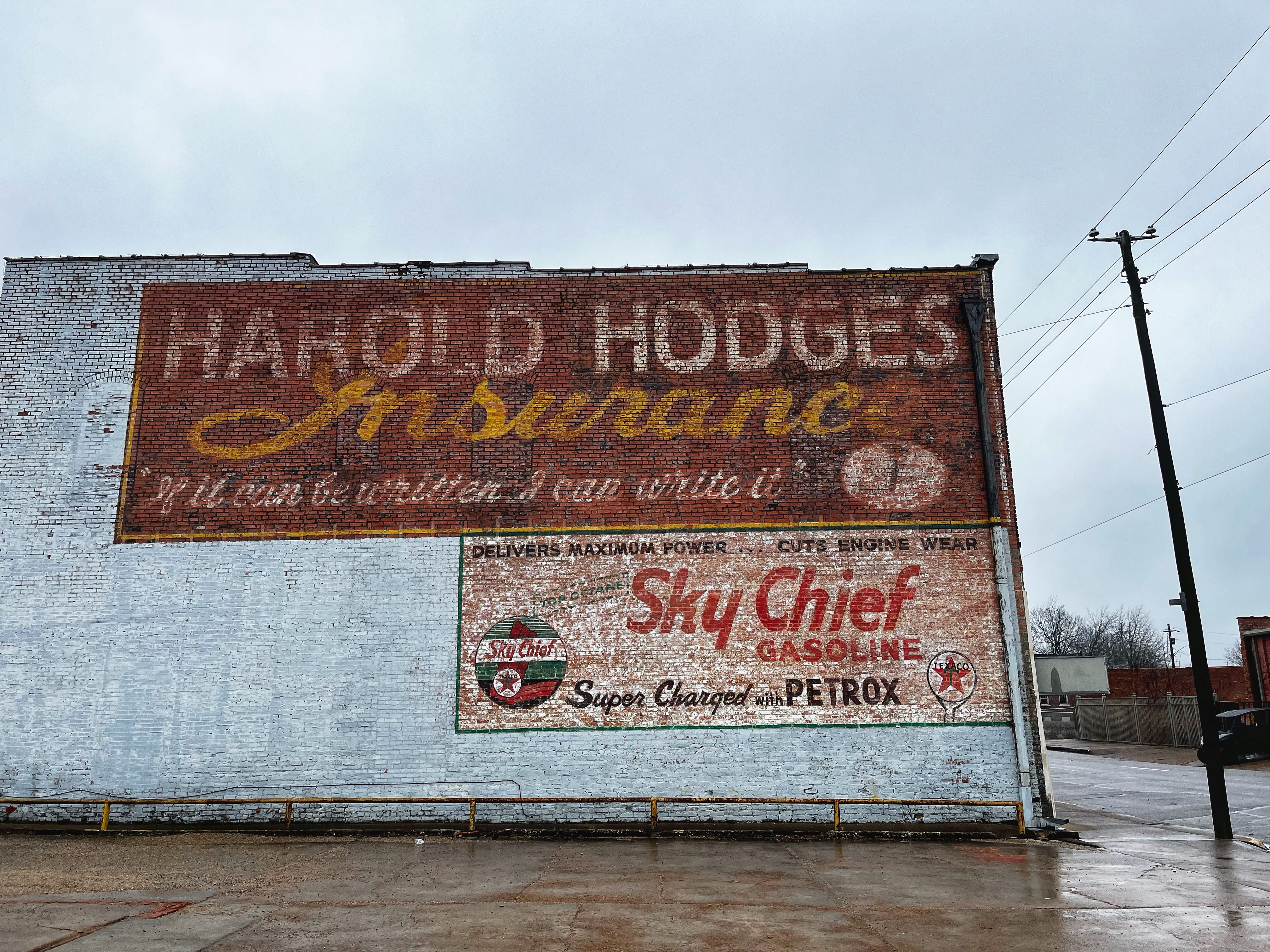
We stopped to eat at a taqueria downtown (not as good as either of us had hoped), then we circled the town square once to burn off half the calories we’d just eaten. When it started to drizzle, we got back in the van and made our way to the Eiffel Tower—because when in Paris, any Paris, one must indeed visit The Tower.
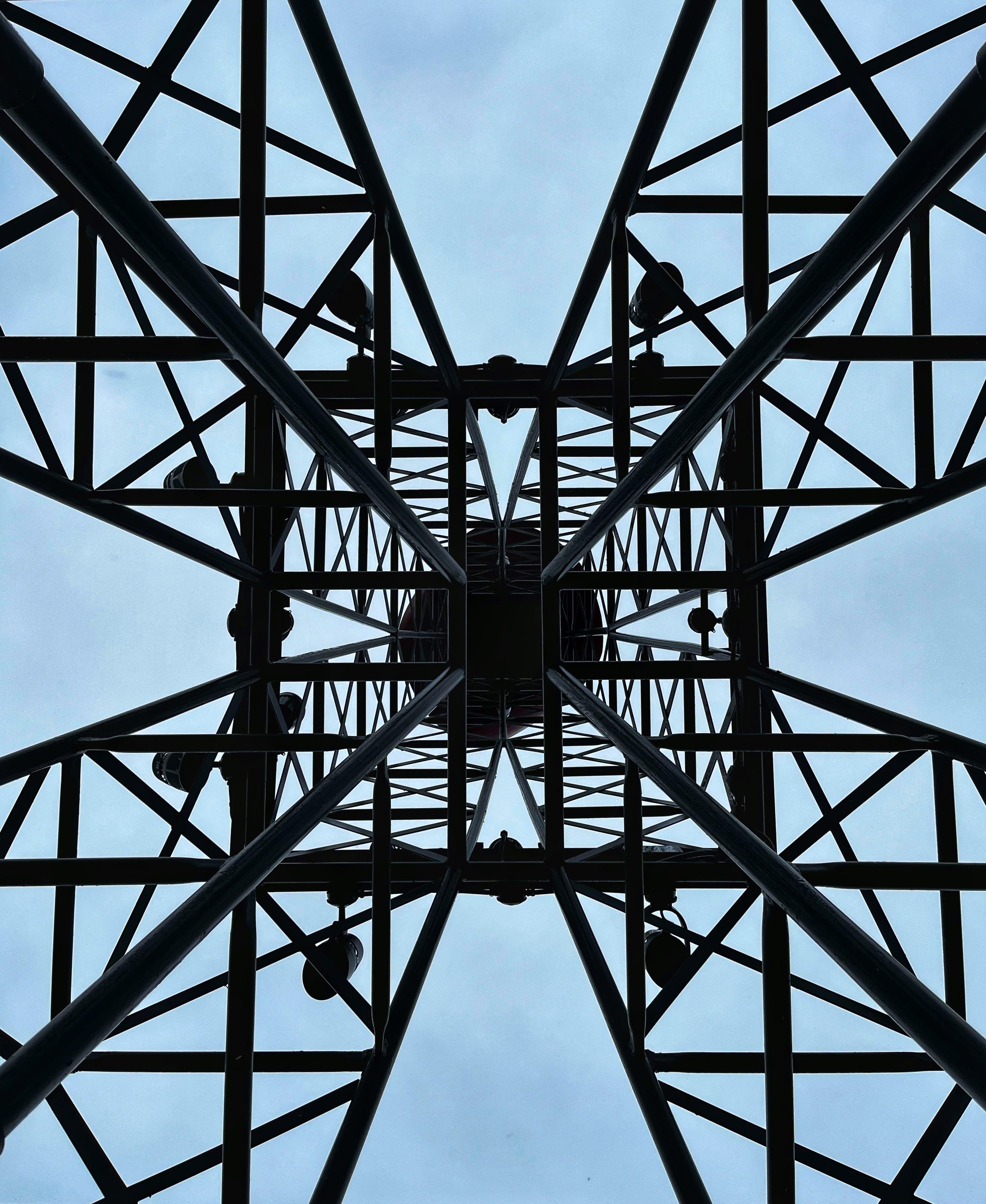
The Texas structure, 65 feet tall if it’s an inch, sprouts at the heart of all those Chamber of Commerce brochures. Built in 1993, presumably as a response to the 60-foot tower in Paris, Tennessee, the architects of the Texas Paris plopped a giant cowboy hat, red as a maraschino cherry, atop its tower, assuring its shadow will fall longer across the dry soil of Lamar County. Take that, Tennessee!
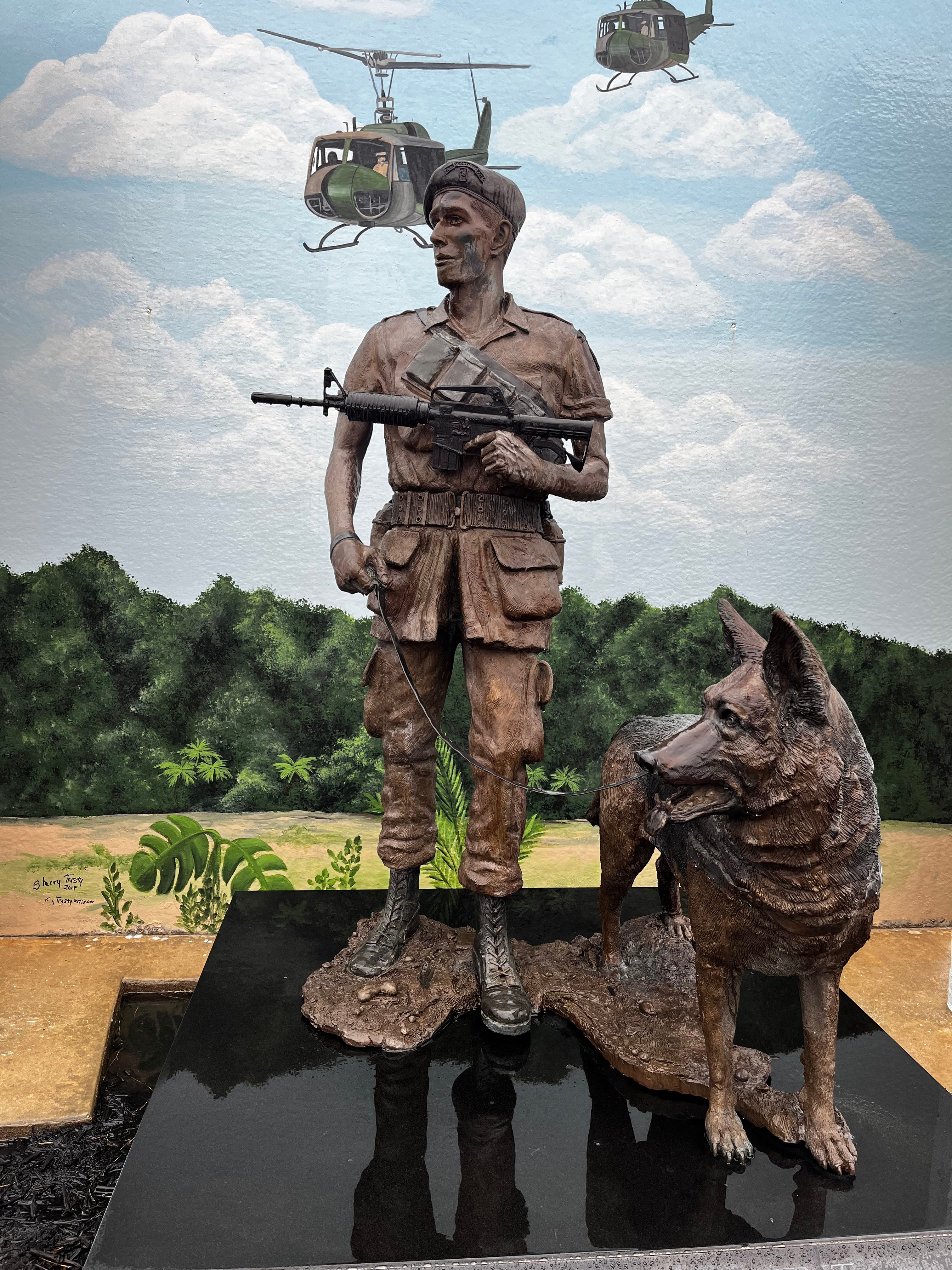
There is, to the best of my knowledge, no mention of Henry Smith, the Arthur Brothers or Brandon McClelland at the Texas Eiffel Tower. There is, however, a large courtyard, big as two city blocks, filled with flag-waving salutes of praise to “our nation’s veterans.” The bronze statues all have white servicemembers’ features.
As the rain continued to spit from the sky, I was happy to discover we could park in the Eiffel Tower’s parking lot—which was really the civic center’s spacious (and empty) parking lot. We were even able to plug in to an outlet on one of the many posts fronting the parking spaces at the back of the parking lot. Electricity and a free parking space! Life was good.
By nightfall, there was a nice little stream running merrily along in a ditch just in front of Sugar. I paid little mind to it as Jean and I retired for the night, crawling into bed with our three cats.
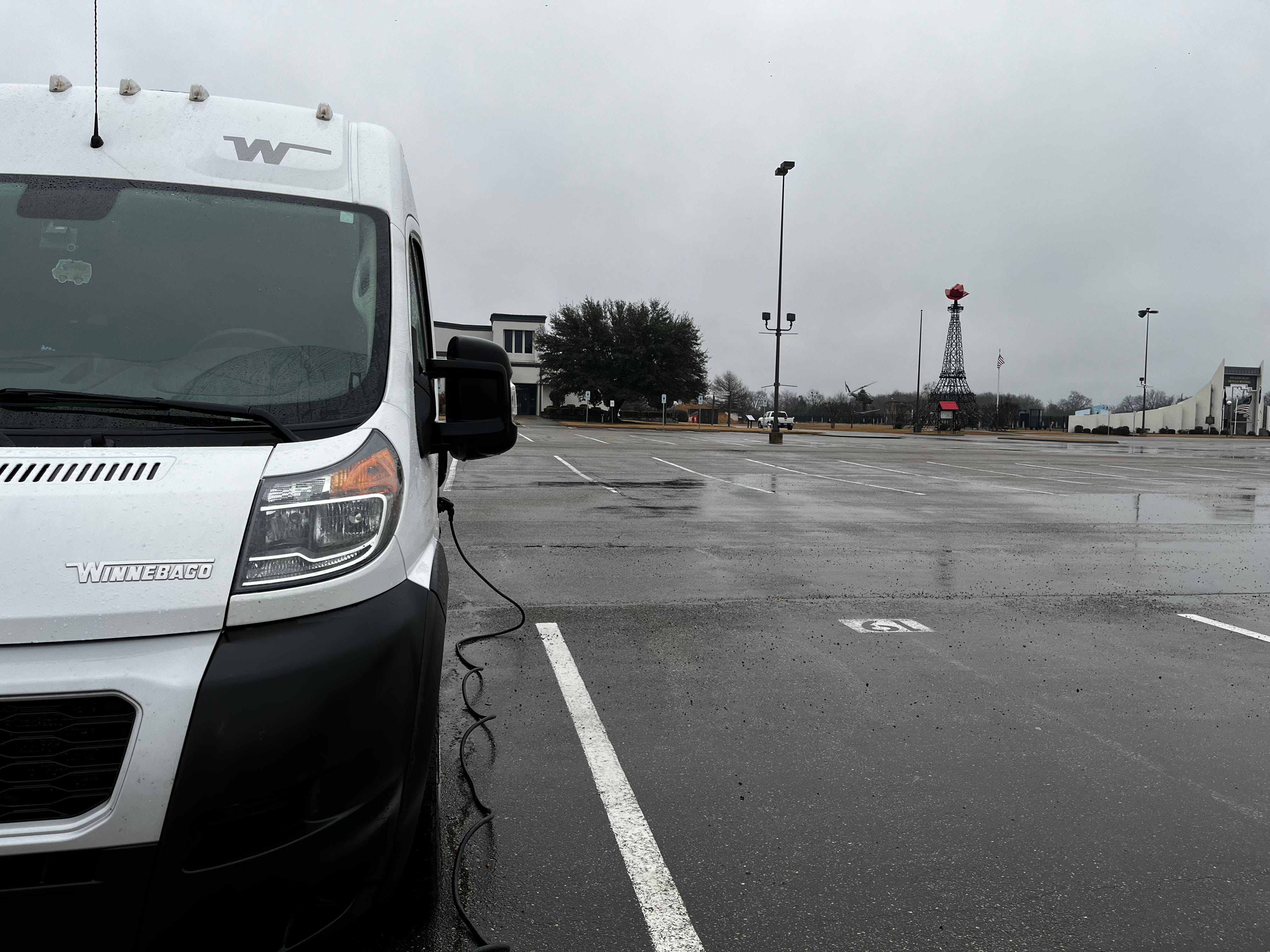
Just before midnight, the thunder rolled through, sounding like your drunk upstairs neighbors moving furniture back and forth across their hardwood floors. The rain also picked up, spraying droplets across Sugar’s hide in a gust of wind. I turned over and went back to sleep.
January 30, 2025: We got up, as usual, shades still buttoned up, as usual, fed the cats, as usual, made coffee, as usual, then I sat down to read and Jean clapped on her headphones to watch TikTok videos, as usual.
But something felt unusually off.
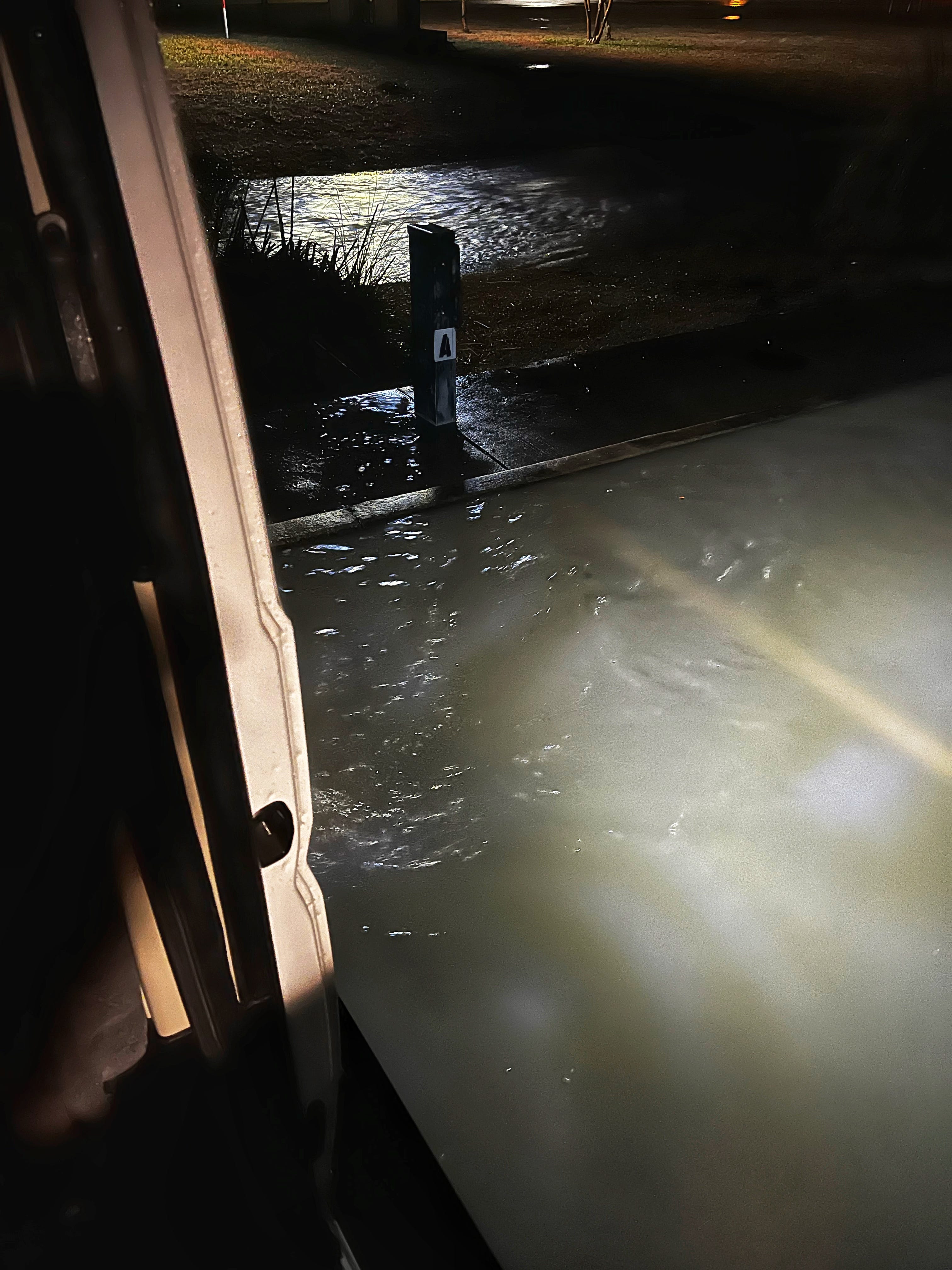
I set down my coffee, flicked on the exterior light, and opened the sliding door. A river of muddy water flowed smoothly less than an inch below Sugar’s running boards. That small stream that ran in front of Sugar last night was now a rapid-flowing current licking up the bank toward us.
I looked at Jean and yelled loud enough to be heard through her headphones: “Flood!”
Jean sat up, saw through the opened door. “Ho-ly!”
I leaned out, scouted both ways, determined we were smack in the middle of the newest river in Paris, Texas. We needed to back up to “higher ground” in the parking—closer to la tour Eiffel—but first I had to unplug.
I winced, I moaned, I groaned, but eventually I took off my shoes, rolled up the bottoms of my pajama pants, and stepped into Parking Lot River. God-damn was it cold! And muddy. I couldn’t see my feet past the middle of my shins—that’s how deep it was. I surged shin-first through the water around the back of Sugar, flashlight bobbing across the surface before me, watching for wriggling snakes. The only thing I found snaking in the water was the power cord tethering us to the post: it bobbed thick and black in the current, trying to tug free of the outlets—it couldn’t, but it was trying. Yes, I stood in water while unplugging the cord from Sugar’s side; yes, I waded back to the post and unplugged the other end there—and yes, miraculously, I suffered no electrical shock knocking me from my feet back into the water. I was safe and sound and there the black cord lay coiled wetly at our feet inside Sugar. I turned the key and backed up hastily to a place where the tires were no longer submerged in water.
Jean and I had planned to spend the day in Paris: doing laundry, going to the library so I could connect to wifi on my computer, and maybe finding some place better to eat in town before returning for another night of free electricity at the Tower.
Now, the county—and many surrounding counties—were under a Flood Watch. Change of plan, pivot: get away from the flood zone. Get away from Paris altogether.
It took a long time, 90 minutes of white-knuckled driving through highways blanketed with rain, unexpectedly hitting a patch of deep tire-slowing water, standing pools that exploded like water mines beneath us when we passed over. I worried about the batteries suspended beneath Sugar’s carriage, hoped they weren’t going to short out. For too many miles, I followed truckers whose backsplash flooded my windshield with extra water. When I could, I passed them, gritting my teeth, whitening my knuckles, pressing the accelerator just enough to edge forward past them in a buffeting slurry of water. I was running from something, some force of evil in the weather that pursued us with a howl of wind and thunder.
I made it through the rest of the state, passing new-sprung lakes in farmlands and surging creeks frothing over the banks. I made it through and reached relatively dry land in Louisiana. The curtain of rain lifted and then, ahead in the distance, we saw a large blue sign: “Welcome to Louisiana.” We nearly cried with relief.
Finally, we were through with Texas.
We’d manage to escape Paris, in our white van carrying a load of white privilege, pushed out of the state by brown floodwaters that seemed to say we had no business there anyway.
Reading this back to myself 10 months later, I’m struck by how ignorant, how self-centered, how utterly cynical it sounds. Back then, I felt like a leaky boat sinking by slow degrees with every depressing headline I read. I can’t blame myself, really. Those were the early days of the Trump administration when the bull was charging in the china shop breaking every plate in sight.
It’s gotten considerably worse since then, of course, but that cynicism has also led to hope. When I hit the bottom of despair, I had no other direction to go but bounce upward. As Rebecca Solnit writes in the Introduction to the third edition of her book Hope in the Dark:
It’s important to emphasize that hope is only a beginning; it’s not a substitute for action, only a basis for it. “Not everything that is faced can be changed, but nothing can be changed until it is faced,” said James Baldwin. Hope gets you there; work gets you through.
In my research for this essay, I also found a story from 2020 which gave me reason for hope beyond the historic atrocities of strange fruit hanging from trees, bodies swaying in the wind, bodies being dragged to pieces behind pickup trucks. My heart lifted when I found this Texas Monthly story12 of some Paris, Texas residents who are doing the “work of hope.”
The magazine article by Katie Nodjimbadem begins like this:
Carolyn Williams, a 66-year-old great-grandmother who has lived in Paris for over forty years, was used to lonely protests. For years, she had attended demonstrations against police brutality and racial discrimination in the northeast Texas town featuring just a handful of other people. Sometimes she was the only one. In late May, when she decided to organize a protest in response to the killing of George Floyd at the hands of Minneapolis police officers, she wasn’t sure if anyone else would join her. Nonetheless, she posted her plans on Facebook, crafted a sign demanding “Justice for George Floyd,” and made her way to the downtown plaza, determined to speak out, even if she was the only one who showed up.
But when she reached the plaza, she found that two other women, one Black and one white, neither of whom she had met before, were already there, holding their own homemade signs. Throughout the evening, others trickled into the square, and by the end of the night, about twenty protesters had gathered. To Williams’s surprise, roughly half were white.
I read that and laid it alongside this equally encouraging quote from Solnit’s Hope in the Dark: “Hope locates itself in the premises that we don’t know what will happen and that in the spaciousness of uncertainty is room to act. When you recognize uncertainty, you recognize that you may be able to influence the outcomes—you alone or you in concert with a few dozen or several million others.”
The Texas Monthly article continues with what Solnit would call “a torch we can carry into the night”:
That May protest in Paris wasn’t a one-off. Williams and other activists have since organized several more demonstrations, including one on June 4 that attracted about 100 marchers along the perimeter of the plaza. For Black activists in Paris, a city of 25,000 that was largely bypassed by the civil rights movement of the sixties, the protests were both welcome and overdue. “A march in Paris, Texas, is an indicator of the possibility of change, more so than a march in New York or Chicago,” said Dwight D. Watson, the author of Race and the Houston Police Department and a retired professor of African American history at Texas State University. “Give me Paris, Texas, and I’ll give you a changed world. Because if it’ll change there, it’ll change everywhere.”
So, I leave you with the flickering torch of hope. Things can get better, by small and incremental degrees. Even in Paris, Texas.
https://en.wikipedia.org/wiki/Paris,_Texas
https://historymatters.gmu.edu/d/5487/
https://voicesofdemocracy.umd.edu/wells-lynch-law-speech-text/
https://www.gutenberg.org/files/14977/14977-h/14977-h.htm
https://en.wikipedia.org/wiki/Lynching_of_Irving_and_Herman_Arthur
https://books.google.com/books?id=0km_frJZALIC&pg=PA139#v=onepage&q&f=false
Chapman, David Lynn (August 1973). Lynching in Texas, Texas Tech University
https://en.wikipedia.org/wiki/Death_of_Brandon_McClelland
https://en.wikipedia.org/wiki/Murder_of_James_Byrd_Jr.
https://www.paristexas.com/
This despite the fact that Wenders’ crew rented my RV and my driving services as a sort of mobile dressing room when he was in Butte, Montana to make a short film about artist Edward Hopper—which I also haven’t yet seen! This RV, a 24-foot Thor Vegas, was the predecessor to Sugar the campervan and was much too large for our needs, though it was perfectly-sized for the film crew.
https://www.texasmonthly.com/news-politics/black-lives-matter-movement-paris-texas/
Absolutely wonderful post. Thanks!